
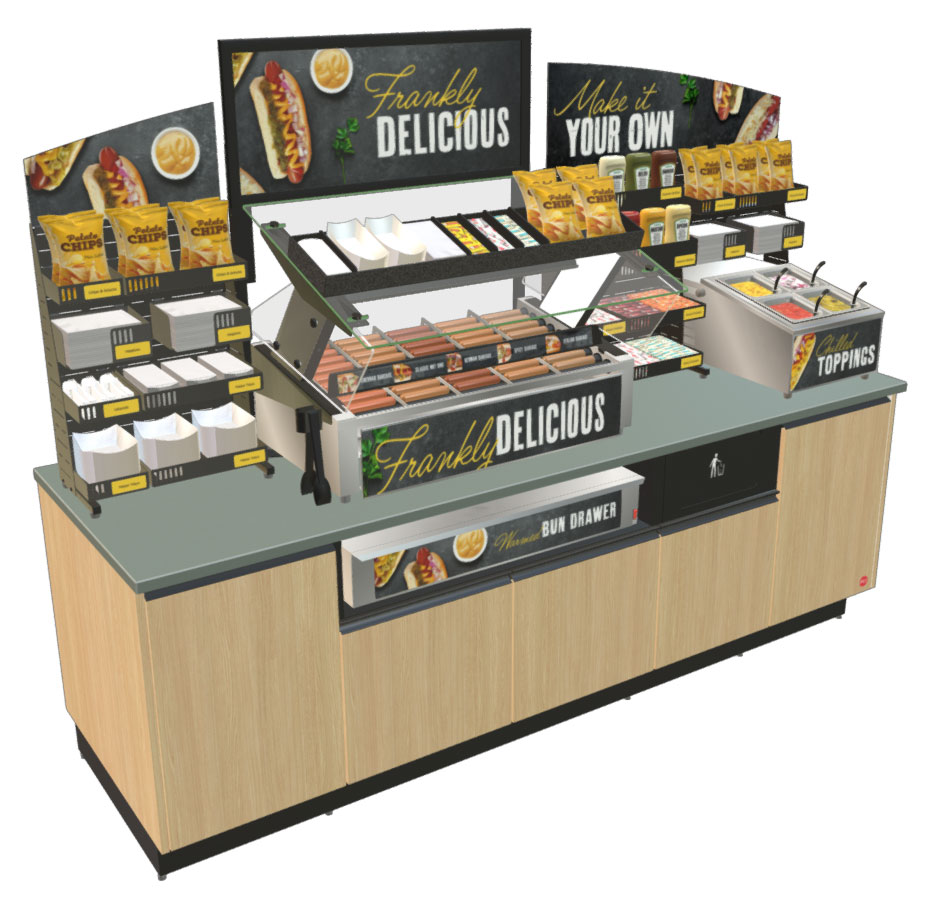
How to Choose the Right Grill and Build a Program That Works
Written by: Elaine Bogen, Digital Marketing Manager
Reviewed by: Brad Duesler, Founder & CEO, Food Concepts, Inc. (FCI)
Published: September 2026
Last reviewed: September 2026
Buying a commercial roller grill can look pretty straightforward.
Pick a size. Pick a model. Put it on the counter.
But the grill is only one part of the decision.
The right roller grill needs to match what you plan to serve, how much you expect to sell, when demand occurs, the space available, the people responsible for operating it and the rest of the foodservice station around it.
Capacity matters. So do throughput, product mix, controls, utilities, cleaning, food protection, serviceability and what happens once the grill is actually in operation.
The better question is not simply:
Which roller grill should I buy?
It is:
What roller grill and program configuration fits the way my operation actually works?
This commercial roller grill buying guide walks through that decision from beginning to end.
Important: Features, capacities, electrical specifications, certifications, approved food products, cleaning procedures and operating capabilities vary by manufacturer and model. Confirm current specifications and operating instructions for the equipment and food products you are considering.
In This Guide
- Start with program fit
- Size for peak demand, not average sales
- Choose the menu before the equipment
- Design the complete roller grill station
- Select the right roller grill configuration
- Verify utilities, installation and food protection
- Plan for daily execution
- Evaluate cost, service and uptime
- Measure the program after launch
- Use the final buying checklist
Commercial Roller Grill Buying Guide: 7 Steps to Choosing the Right Grill
Before comparing individual models:
- Confirm a roller grill fits your menu and service model.
- Estimate peak-period demand and the amount of product that needs to be ready to sell.
- Choose the product mix and confirm how those foods must be prepared and held.
- Design the complete station, not just the space occupied by the grill.
- Confirm electrical, food-protection and installation requirements.
- Compare capacity, configuration, controls, roller surfaces, serviceability and support.
- Measure sales, availability and waste after launch and adjust the program accordingly.
That sequence makes the equipment decision much easier.
1. Start With Program Fit
A commercial roller grill can be a strong hot-food option when customers need food that is visible, ready to purchase and relatively simple to serve.
Roller grills are commonly used in:
- Convenience stores
- Travel centers
- Stadiums and arenas
- Concession stands
- Colleges and universities
- Corporate cafeterias
- Hospitals
- Recreation facilities
- Entertainment venues
- Other grab-and-go foodservice environments
But wanting to offer hot food does not automatically mean a roller grill is the right answer.
Start by asking:
- What products will we sell?
- When will customers buy them?
- How much demand do we expect during peak periods?
- Will customers serve themselves?
- Who will replenish and monitor the station?
- Who will clean it?
- Do we need food continuously available or primarily during defined rush periods?
A roller grill works best when the menu, traffic and labor model support the program.
If the concept requires extensive customization, constant employee involvement or preparation the equipment is not designed to perform, another hot-food format may be a better fit.
Operational Note: Start With the Program
One of the easiest mistakes in foodservice planning is starting with the equipment.
Start with the customer, menu, traffic and labor model.
Then choose the equipment that supports them.
2. Size for Peak Demand, Not Average Sales
Capacity is one of the first specifications buyers see.
It matters.
But capacity and throughput are not the same thing.
Capacity tells you how much product physically fits on the grill at one time.
Throughput tells you how much product the operation can realistically prepare, replenish and sell over a period of time.
That distinction can change the buying decision.
A smaller grill that is replenished effectively may serve an operation better than a larger grill that spends much of the day carrying excess product and occupying valuable counter space.
Start with the busiest periods, not the daily average.
Consider:
- Peak unit sales
- Sales by daypart
- How quickly products sell
- Required preparation or heating time
- How much ready-to-sell inventory is needed
- How often employees can replenish
- How many products will share the grill
- Waste risk during slower periods
How Much Roller Grill Capacity Do You Need?
The goal is not to fill every available inch of grill space.
The goal is to maintain enough ready-to-sell product to meet demand without creating unnecessary waste or consuming more footprint than the program needs.
Capacity vs. Throughput Example
Suppose a location needs about 40 ready-to-sell roller grill items during its busiest lunch period but only 12 to 18 later in the afternoon.
That does not automatically mean the location needs a 40-count grill.
If employees can replenish consistently and the product mix allows it, a smaller grill with the right configuration and replenishment plan may be able to meet peak demand while carrying less excess product during slower periods.
Final capacity should always reflect the preparation and holding requirements of the products being sold and the capabilities of the specific equipment.
Operational Note: Bigger Is Not Automatically Safer
Extra capacity can mean more product sitting during slower periods, more rotation work and more counter space devoted to inventory that is not selling.
The right capacity balances availability with replenishment, waste and footprint.
Compare commercial roller grill capacities, roller counts and footprints.
3. Choose the Menu Before the Equipment
“Hot dog roller” does not fully describe what commercial roller grills may be used for.
Depending on the specific food and equipment, roller grill programs may include products such as:
- Hot dogs
- Bratwurst
- Sausages
- Breakfast sausages
- Taquitos
- Roller bites
- Other products specifically designed and approved for roller preparation
But product compatibility should never be assumed.
A roller grill should not be treated as a universal appliance for cooking any food that happens to fit between the rollers.
Products may arrive fully cooked, require reheating, require cooking or have specific holding requirements.
Before choosing equipment, confirm:
- What products will be offered
- How each product is intended to be prepared
- Whether the equipment is appropriate for that product
- Whether different products require different settings
- How long products can remain available for sale
- Whether products need physical separation
- How employees and customers will identify each item
Follow the food manufacturer’s preparation instructions, the equipment manufacturer’s operating instructions and applicable food-safety requirements.
More Variety Is Not Automatically Better
A larger assortment can help a roller grill serve multiple dayparts.
But every item occupying space should have a reason to be there.
Look at what actually sells, how products perform by daypart and whether slower items are adding meaningful choice or simply increasing complexity and waste.
4. Design the Complete Roller Grill Station
One of the easiest mistakes to make is measuring for the grill and forgetting everything around it.
A complete roller grill station may also need:
- Food protection
- Bun storage or warming
- Tongs
- Product dividers
- Product identification
- Packaging
- Napkins
- Condiments
- Chilled toppings
- Signage
- Waste collection
- Nearby holding or support equipment
Measure the entire station footprint, not just the dimensions of the grill.
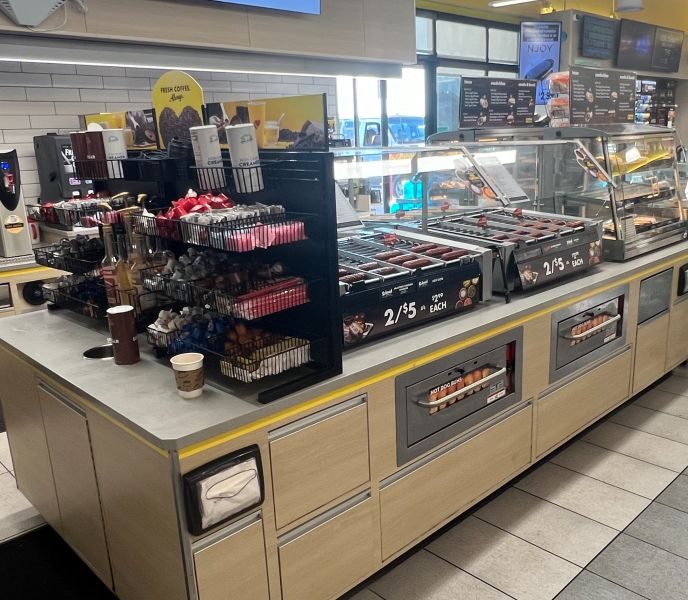
Then look at the station from two perspectives.
What Does the Customer Need?
Can customers:
- See the food clearly?
- Understand what each item is?
- Reach the product comfortably?
- Find buns, condiments, packaging and utensils?
- Move through the station without unnecessary friction?
What Does the Employee Need?
Can employees:
- Load and replenish product?
- Reach the controls?
- Access the grill without disrupting customers?
- Remove trays and components?
- Clean beneath and around the equipment?
- Restock buns, packaging and condiments?
- Service the station during busy periods?
A grill can fit the counter perfectly and still be a poor fit for the operation.
Don’t Forget the Buns
If the program includes hot dogs or sausages served in buns, bun capacity should be considered alongside grill capacity.
Depending on the operation, options may include:
- Bun storage
- Heated bun cabinets
- Integrated drawers
- Separate bun warmers
Think about capacity, space, replenishment and whether the bun system can keep pace with peak grill demand.
Explore roller grill food shields, bun warmers, dividers and accessories for a complete station.
Operational Note: Stock the Entire Purchase Path
A full roller grill does not help much if the customer cannot find a bun, tongs, condiments, packaging, napkins or a clear product label.
Stock the entire purchase path, not just the grill.
Roller Grill Station Planning at a Glance
A strong station typically accounts for three zones.
Customer-Facing Zone
Product visibility, labels, tongs, buns, packaging, condiments, napkins and clear access.
Equipment Zone
Roller grill, food protection, electrical access, holding support and refrigerated toppings where applicable.
Employee-Facing Zone
Replenishment, storage, controls, cleaning access, service clearance and waste.
These three zones should be planned together before equipment is ordered.
5. Select the Right Roller Grill Configuration
Once the operation, demand, menu and station are defined, equipment comparison becomes much more useful.
Commercial Roller Grill Configuration Comparison
| Decision | Often makes sense when | Main question to ask |
|---|---|---|
| Smaller-capacity grill | Demand is moderate, space is limited and replenishment is reliable | Can employees replenish before stockouts occur? |
| Larger-capacity grill | Peak demand is high and ready-to-sell availability is critical | Can product turn fast enough to control waste? |
| Flat configuration | Counter integration or multi-sided viewing matters | Where will customers and employees stand? |
| Slanted configuration | Front-facing merchandising and visibility matter | Can customers see and reach the product comfortably? |
| Analog controls | Simplicity and familiar operation are priorities | Will employees use the settings consistently? |
| Digital controls | More precision or standardized procedures are valuable | Will employees be trained to use the features correctly? |
| Multiple heating zones | Demand changes by daypart or multiple products are offered | Will the operation actually use the zones? |
Flat vs. Slanted Roller Grills
One of the most visible differences between commercial roller grills is the angle of the cooking surface.
Flat Roller Grills
A flat grill may be appropriate when:
- The grill is primarily employee-operated
- Maximum usable cooking area is a priority
- Customer merchandising is less important
- The equipment is integrated into a counter
- Customers view the station from more than one direction
Slanted Roller Grills
A slanted or stadium-style grill angles products toward the customer.
That may be valuable when:
- The grill faces the customer
- Product visibility matters
- The program relies on impulse purchases
- Customers serve themselves
The choice depends on whether the grill is primarily functioning as cooking equipment, merchandising equipment or both.
Roller Surface
Depending on manufacturer and model, rollers may use chrome, nonstick or other coated or textured surfaces.
When comparing them, consider:
- Product compatibility
- Ease of cleaning
- Coating durability
- Approved cleaning methods
- Long-term maintenance
- Warranty implications
Ask:
Can our staff consistently clean and maintain this surface the way the manufacturer requires?
Heating Zones
Independently controlled heating zones may give an operation more flexibility.
Depending on the model, separate zones may help operators:
- Run less active grill space during slower periods
- Prepare product in one section and hold in another, where approved
- Manage multiple products
- Adjust the grill as traffic changes by daypart
More zones are useful only when the operation has a practical reason to use them.
Drive System
High-volume operators should also look beyond temperature controls.
Some roller grills use separate drive mechanisms for different sections.
Depending on the design, this may provide additional flexibility and may reduce the impact of a service issue.
Ask:
- How are the rollers driven?
- Are sections operated independently?
- What happens if a drive component fails?
- How easily can motors or drive components be serviced?
It is an easy specification to overlook until the grill stops rolling.
Analog vs. Digital Controls
Analog controls can offer straightforward operation and familiarity.
Digital or electronic controls may provide greater precision or additional programming capabilities, depending on the equipment.
The best controls are not necessarily the controls with the most features.
They are the controls employees can use correctly and consistently every day.
6. Verify Utilities, Installation and Food Protection
Do not wait until delivery day to discover the grill needs something the location cannot provide.
Before ordering, confirm:
- Voltage
- Amperage
- Wattage
- Phase
- Plug configuration
- Circuit requirements
- Available electrical service
Then consider the entire station load.
The grill may share the foodservice destination with bun warming, refrigeration, lighting or other powered equipment.
A station that fits physically still needs to work electrically.
Certifications and Local Requirements
Depending on the equipment and application, commercial foodservice equipment may carry sanitation and electrical certifications or listings.
Requirements can vary by jurisdiction, facility and installation.
Confirm applicable requirements before purchase, particularly in self-service environments.
Food Protection
Food protection should be planned with the station rather than added after the fact.
The right food shield needs to protect the food while still allowing the operation to function.
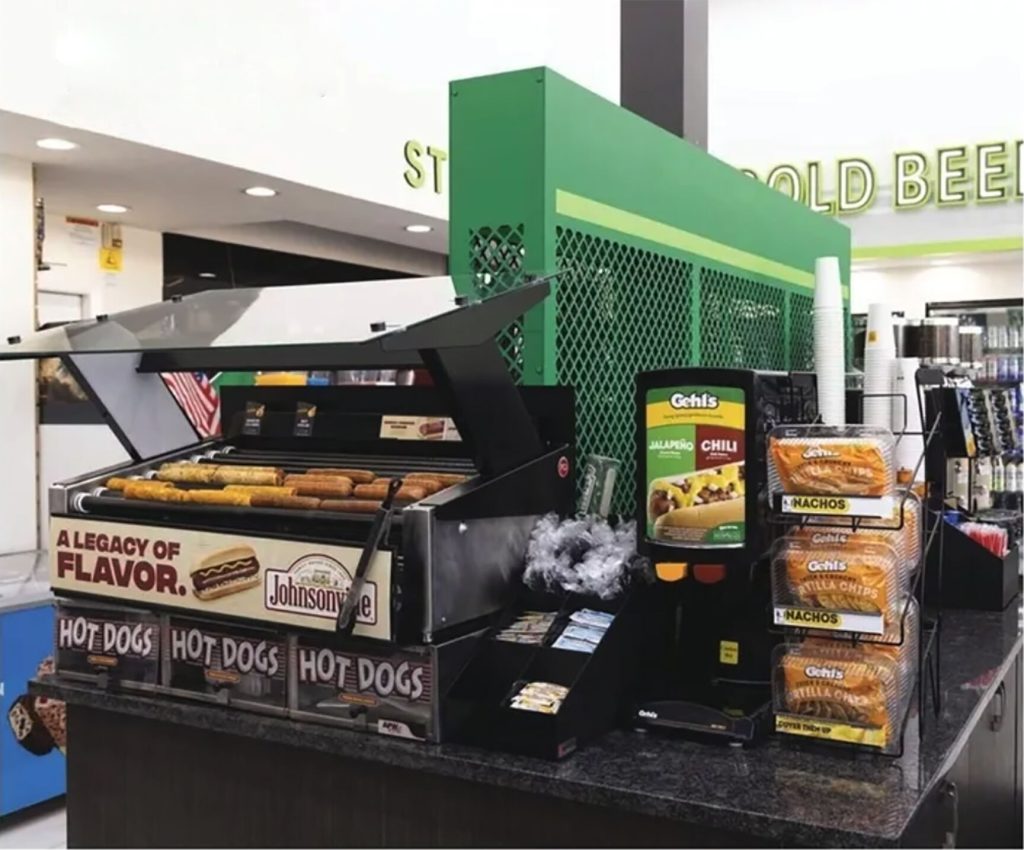
Consider:
- Product visibility
- Customer reach
- Employee access
- Replenishment
- Cleaning
- Adjustability
- How the shield interacts with surrounding equipment
The right food shield supports food protection without creating a visibility, access or cleaning problem.
7. Plan for Daily Execution
Customers see hot food ready to grab.
Employees see everything required to keep it that way.
A roller grill program may require employees to:
- Load product
- Monitor preparation and holding
- Rotate or replenish products
- Restock buns
- Maintain packaging
- Restock condiments
- Monitor food quality
- Clean the grill
- Clean the surrounding station
- Track waste
That makes labor part of the buying decision.
Ask:
Can the team realistically execute this program during the busiest parts of the day?
A roller grill can simplify a hot-food program.
It does not eliminate labor.
Equipment can reduce complexity. It cannot compensate for unclear responsibility, weak training or an assortment that requires more attention than the location can provide.
Cleaning Belongs in the Buying Decision
Before selecting a grill, understand:
- How the rollers are cleaned
- Which cleaning products and tools are approved
- Whether drip or grease trays are removable
- How employees reach beneath the rollers
- Whether food protection interferes with cleaning
- Which components can be removed
- Whether the process fits the location’s closing routine
The easiest unit to buy is not always the easiest unit to operate.
Review commercial roller grill cleaning and maintenance guidance.
8. Evaluate Cost, Service and Uptime
The purchase price is only one part of the cost of commercial equipment.
Before buying, look at what happens after the sale.
Consider:
- Warranty coverage
- Replacement-part availability
- Ease of service
- Technical support
- Access to motors, controls and heating components
- Expected durability
- Cleaning and maintenance requirements
- Energy use
- Potential downtime
A lower initial price can become much less attractive if a relatively small problem takes the entire grill out of service or replacement parts are difficult to obtain.
For a high-volume operation, downtime is not simply a repair expense.
It can also mean lost food sales, lost basket attachment, customer disappointment, labor disruption and emergency replacement costs.
Think About Total Cost of Ownership
Compare more than the invoice price.
Total ownership considerations may include:
Purchase price + installation + energy + cleaning labor + maintenance + repair + product waste + downtime
The purpose is not to create false precision.
It is to understand what contributes to the real cost of owning and operating the equipment.
Then ask the bigger question:
Is the program generating enough value to justify the space, labor, equipment and inventory it requires?
9. Measure the Program After Launch
The buying decision does not end when the roller grill is installed.
Once the program is operating, actual sales and operational data can tell you whether the original assumptions were right.
Track:
- Unit sales by product
- Sales by daypart
- Units sold during peak windows
- Out-of-stock periods
- Product waste
- Replenishment frequency
- Product mix
- Promotion and limited-time-offer performance
- Beverage, snack or side attachment
- Gross margin contribution, where available
- Labor effort required to maintain the station
Then turn those numbers into decisions.
| If the data shows… | Consider… |
|---|---|
| Repeated lunch stockouts | More ready-to-sell inventory, faster replenishment, additional capacity or a tighter assortment |
| High late-night waste | Fewer products, less active capacity or a smaller late-night assortment |
| One consistently slow item | Removing it, limiting it to another daypart or replacing it |
| Strong beverage attachment | Better combo messaging or closer beverage placement |
| Frequent employee interruptions | Reworking supply storage, access, layout or staffing responsibility |
| Consistent unused capacity | Reducing active capacity or reconsidering grill size at future locations |
This is where equipment planning becomes program management.
The roller grill is equipment. The roller grill program is a business.
Measure it that way.
Before You Order: Commercial Roller Grill Buying Checklist
Program and Demand
☐ Roller grill fits the menu and service model
☐ Peak demand has been estimated
☐ Dayparts have been considered
☐ Replenishment frequency is realistic
☐ Required ready-to-sell inventory is understood
Menu and Food Requirements
☐ Products have been selected
☐ Preparation requirements are confirmed
☐ Equipment is appropriate for intended foods
☐ Multiple-product separation needs are understood
☐ Product identification is planned
Space and Customer Flow
☐ Grill footprint is measured
☐ Entire station footprint is measured
☐ Customer reach and visibility are considered
☐ Employee replenishment access is adequate
☐ Cleaning and service clearances are available
☐ Buns, condiments, packaging and utensils have designated space
Equipment and Utilities
☐ Flat or slanted configuration selected
☐ Roller surface evaluated
☐ Heating-zone needs determined
☐ Control type evaluated
☐ Drive-system design considered
☐ Voltage confirmed
☐ Amperage confirmed
☐ Wattage confirmed
☐ Phase and plug confirmed
☐ Circuit requirements confirmed
☐ Total station electrical demand reviewed
Food Protection and Installation
☐ Food protection requirements are confirmed
☐ Food shield supports customer and employee access
☐ Applicable certifications are confirmed
☐ Local installation requirements are confirmed
Cleaning, Service and Ownership
☐ Cleaning process reviewed
☐ Approved cleaning products and tools identified
☐ Warranty reviewed
☐ Replacement-parts availability confirmed
☐ Service support identified
☐ Downtime risk considered
Performance Measurement
☐ Sales by item will be tracked
☐ Sales by daypart will be tracked
☐ Out-of-stocks will be monitored
☐ Waste will be measured
☐ Replenishment frequency will be reviewed
☐ Basket attachment will be monitored where possible
Commercial Roller Grill FAQs
What Size Commercial Roller Grill Do I Need?
Size the grill around peak demand, required ready-to-sell inventory, product mix, replenishment capability, available counter space and waste risk rather than average daily sales alone.
What Is the Difference Between Roller Grill Capacity and Throughput?
Capacity is the amount of product that fits on the grill at one time. Throughput is the amount the operation can realistically prepare, replenish and sell over a defined period.
Should I Choose a Flat or Slanted Roller Grill?
Flat roller grills may work well where counter integration, employee operation or multi-sided visibility matter. Slanted grills can improve product visibility in front-facing and self-service applications.
Can a Commercial Roller Grill Cook Raw Food?
Do not assume so. Use a roller grill only for foods and preparation processes permitted by the food manufacturer, equipment manufacturer and applicable food-safety requirements.
How Many Heating Zones Should a Roller Grill Have?
The right number depends on product mix, daypart demand and whether the operation benefits from running different sections at different settings or reducing active capacity during slower periods.
What Equipment Is Needed for a Complete Roller Grill Station?
Depending on the operation, a complete station may include the grill, food protection, bun storage or warming, tongs, dividers, product identification, packaging, napkins, condiments, signage, waste collection and refrigerated toppings.
What Electrical Information Should Be Confirmed Before Ordering?
Confirm voltage, amperage, wattage, phase, plug configuration, circuit requirements and the electrical service available at the installation location. Also account for other powered equipment that will be part of the station.
How Should a Roller Grill Program Be Measured After Installation?
Track unit sales by product and daypart, stockouts, waste, replenishment frequency, product mix, promotions, labor requirements and basket attachment where that data is available. Use those results to adjust capacity, assortment, replenishment and daypart strategy.
The Best Roller Grill Fits the Program
There is no universally “best” commercial roller grill.
The right model is the one that fits the operation’s menu, peak demand, dayparts, footprint, utility capacity, labor model, food-protection requirements and service expectations.
Start with the program, not the equipment specification.
Then build the complete station around the customer experience and the employee workflow required to sustain it.
A successful roller grill program is more than a heated display.
It is a coordinated foodservice destination: visible, easy to understand, simple to purchase from, practical to replenish, manageable to clean and valuable enough to earn its space.